
How Solar Carports Help Properties Qualify for Green Building Certifications
For a REIT or large developer, green building certification isn't just a sustainability talking point, it's increasingly tied to financing terms, asset valuation, tenant demand, and portfolio-level ESG reporting. Most certification strategies focus on the building itself: envelope, HVAC, lighting, etc. Parking lots are rarely part of the equation, despite the fact that they make up a significant share of a property's space.
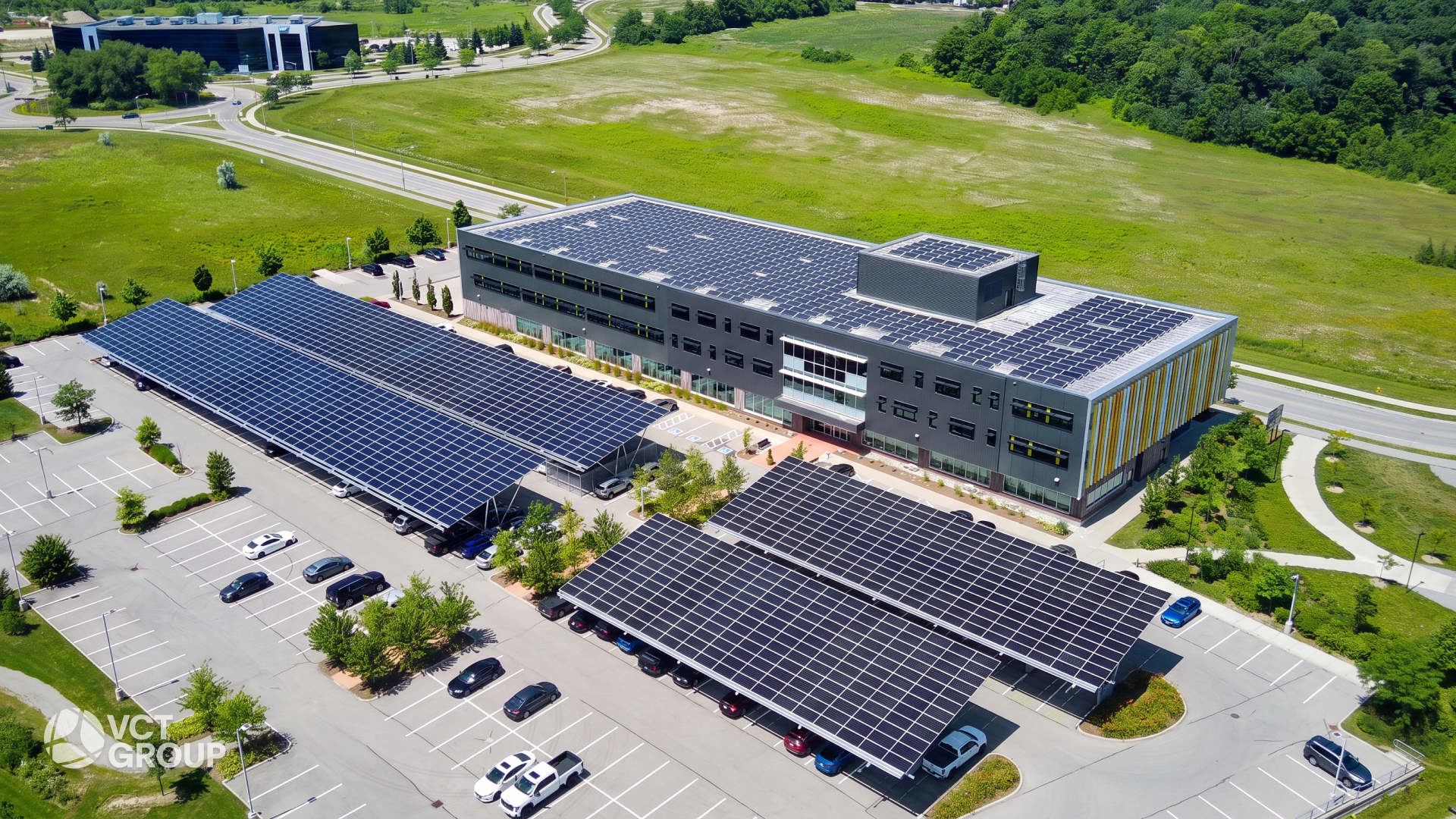
For many properties, parking lot space contributes nothing to green building certification. Parking lots are often underused assets or an afterthought. With solar carports, that can change. We’ll explore why these green building certifications matter, what impact they have, and how solar carports help properties qualify for them.
Why Green Building Certification Matters for REITs and Developers
Investors are increasingly considering sustainability performance when evaluating properties. Green certified buildings may have access to financing options such as green bonds and sustainability-linked loans. Larger corporate tenants with their own ESG goals also increasingly prefer or require green certified buildings.
Certification can also pay off directly for owners: green buildings tend to use less energy and water, which lowers day-to-day operating costs and can add up to significant savings over the life of the building. Because of this, green building certification can potentially affect how quickly space is leased, how much rent can be expected, and how much it costs to operate the property.
For REITs, certifications on one or two buildings isn't enough. Green building certifications need to be visible across the entire portfolio, because investors look at overall ESG performance, not just a few relevant properties.
That makes the REIT approach different from that of a single-building owner. The question isn't simply, "Can we certify this building?" It's, "How can we increase the number of certified properties across dozens or hundreds of buildings without creating a completely different strategy for each one?"
LEED, BOMA BEST, and Zero Carbon Building Standard: Where Solar Fits
LEED, administered by the Canada Green Building Council (CAGBC), is one of the most widely recognized certification frameworks. Three credit categories can apply to solar carports:
On-Site Renewable Energy: A solar carport that offsets building energy use can contribute toward this credit, worth up to 7 points depending on the share of energy needs met on-site. Sometimes a building's rooftop cannot support a full rooftop solar array or is not large enough to meet this criteria on its own. This is where a solar carport can make a big difference.
Heat Island Reduction: Covered parking counts as a compliant shading strategy under this credit, provided the covering structure meets LEED's criteria: solar carports satisfy this while also generating power. Beyond parking, solar carports and canopies can also be extended over green spaces and outdoor gathering areas on the property, turning otherwise unused square footage into another source of shading and clean energy.
Electric Vehicle infrastructure: LEED awards points for installing EV charging equipment at a minimum share of parking spaces, or for making a larger share of spaces "EV-ready" with the electrical capacity in place for future chargers. A carport is a natural place to host EV infrastructure, since the structure and the wiring run are already there.
It’s not just LEED that supports this. BOMA BEST and CAGBC's Zero Carbon Building Standard also recognize on-site renewable generation and EV charging infrastructure as part of their assessment criteria, though the specific scoring system differs from LEED.
For a portfolio strategy spanning multiple certification frameworks, it’s important to understand that on-site solar generation and EV infrastructure are valued under more than one green certification system.
Parking Lots: The Most Underused Green Certification Asset in Your Portfolio
Most commercial, industrial, and institutional properties have large, spanning parking lots. Parking lots, more often than not, cover more surface area than the building itself. Despite this, they are often an afterthought. As is, that parking lot space doesn’t contribute to certification at all, it's just asphalt. Many developers consider rooftop space first.
Rooftops, like parking lots, can provide valuable space for solar and other renewable energy infrastructure. However, if rooftop space is already leased to a solar operator, occupied by HVAC and mechanical equipment, too small to support an efficient rooftop solar array, or unable to support additional loads without structural reinforcement, its potential to contribute to green building certification is limited.
Parking lots don't carry those constraints in the same way. For most properties, a parking lot is open, structurally straightforward to build over, and entirely uncommitted. This makes it a second, largely untapped surface area for generation and certification credit, independent of whatever's happening on the roof.
What Solar Carports Contribute to Green Building Certification
Beyond the specific LEED credits above, solar carports bring a few practical advantages to a certification strategy that a rooftop-only approach doesn't:
Generation without competing for roof space: For properties where the roof is already leased, occupied, or unsuitable, a carport adds generation capacity entirely separate from rooftop constraints.
A natural home for EV charging: The structure and electrical infrastructure needed for solar and for EV charging naturally overlap. Developers can build both at once, which is more efficient than adding EV infrastructure after the fact. Even if you’re not ready to invest yet, solar carports have EV-ready foundations, so you can build a carport without EV chargers initially and decide later if you want them.
Reduced heat island impact: Shaded pavement is cooler than exposed asphalt, addressing a specific, sometimes overlooked certification category while also making the parking experience itself more comfortable for tenants and visitors.
Solar Carports at Portfolio Scale: A Repeatable Model for REITs
A rooftop solar retrofit is usually a custom project because every building and roof has different constraints. Carport solar can be easier to scale because a standardized design can be adapted to each property's parking layout, making costs and timelines more predictable.
That repeatability makes carports a true portfolio-level strategy. For a REIT tracking sustainability progress across dozens of properties, a standardized rollout can deliver more consistent and measurable results than a collection of one-off rooftop projects.
Evaluating solar carports across a multi-property portfolio?
We'll help identify which properties are the strongest fit and what a phased rollout could look like across your assets.