
5 Ways On-Site Solar Generates Business Value
When most businesses think of solar energy, they think sustainability first: a greener footprint, reduced emissions, a better story for stakeholders. While the environmental benefits of solar are real, it’s far from the only business value that comes from it.
This article will help you understand what on-site solar generation can actually do for an Ontario business, and how partnering with VCT Group can help you streamline your solar project.
1 - Reduce Reliance on Grid Electricity
In November 2025, Ontario’s electricity rates unexpectedly went up by 29%. For businesses that rely on power from the grid, even a minor rate increase can have a big impact on what your business takes home at the end of the day.
What makes relying on grid electricity especially frustrating is the unpredictability. Businesses can’t budget for long-term energy costs when rates can shift at any time due to market pressures, infrastructure demand, or policy changes. It makes operational planning far more difficult.
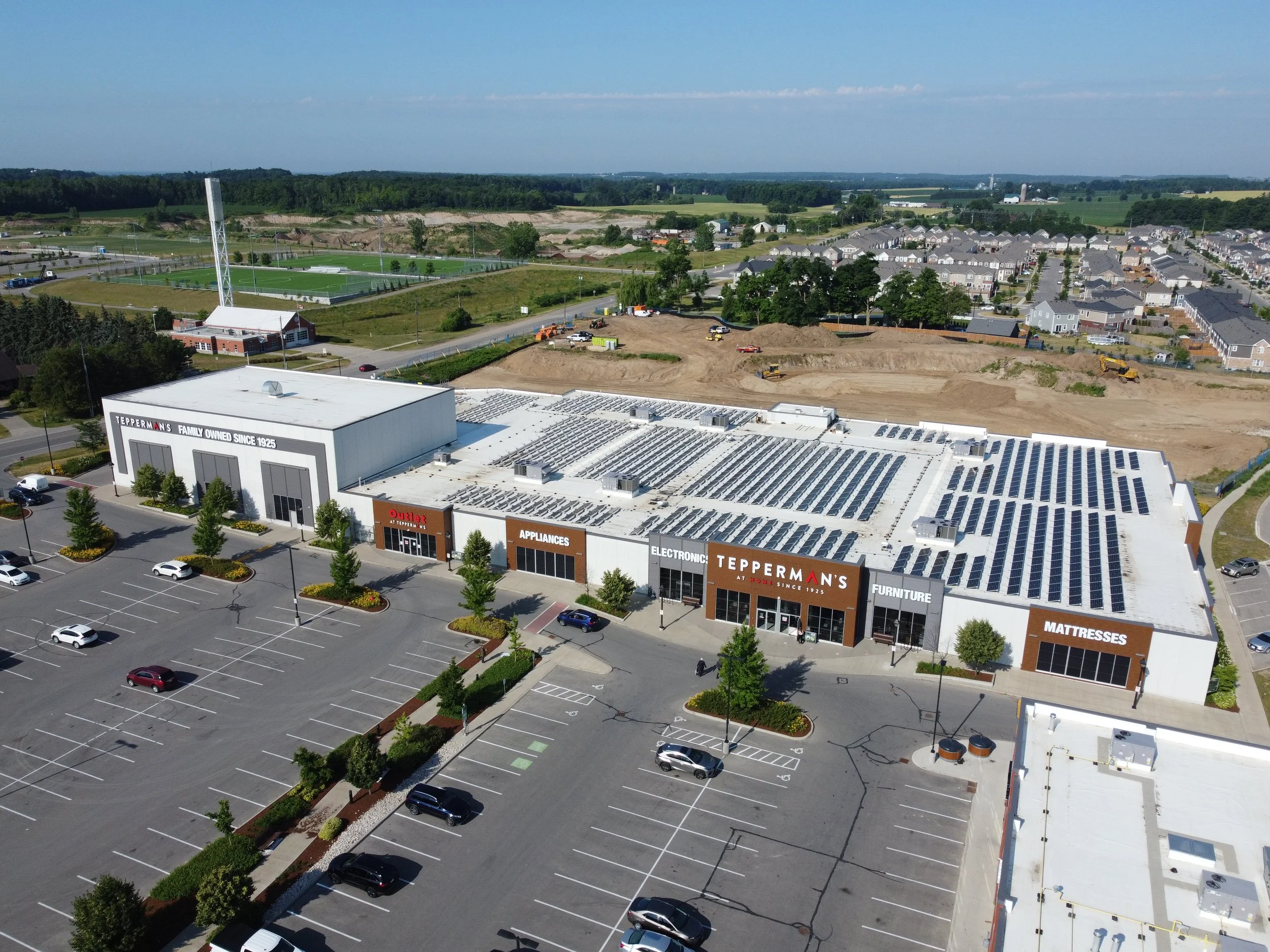
Commercial solar allows businesses to generate a significant portion of their own electricity during the day. For facilities that operate primarily during daytime hours (manufacturing plants, warehouses, retail spaces, food processing facilities, and agricultural operations) this is especially beneficial because the energy is being produced when the business is using it most.
Reducing your draw from the grid means:
Lower exposure to electricity rate increases. Electricity that you generate yourself is electricity you are not buying from the grid.
Reduced demand charges in some configurations. Depending on your load profile, on-site generation can help offset demand peaks during key billing periods.
Greater operational stability. Facilities that cannot afford disruptions benefit from having supplementary generation capacity that is not subject to grid volatility.
2 - Create Additional Revenue Opportunities and Unlock Idle Asset Value
Commercial properties often have significant amounts of underutilized space. In the world of on-site solar, rooftops, parking lots, open land adjacent to buildings can be made into valuable assets.
There are two primary ways businesses in Ontario use underutilized space for commercial solar energy generation:
Direct Ownership
When a business purchases and owns its solar system outright, or finances it through a loan or lease, it keeps 100% of the electricity value generated. Over a system's 25-to-30-year lifespan, this typically represents the strongest long-term financial return.
Capital costs can be high upfront, but federal and provincial incentive programs, including the Clean Technology Investment Tax Credit (CT ITC), can help businesses recoup costs.The CT ITC provides a credit of 30% or more, and that’s one of dozens of incentive programs available for commercial solar projects.
Find more solar incentive programs here: The Ultimate Guide to Solar Rebates in Canada
Power Purchase Agreements (PPAs)
A solar PPA involves a third-party developer that designs, finances, installs, and owns the solar system on your property. The business agrees to purchase the electricity generated by that system at a fixed or predetermined rate for the term of the agreement.
The key benefit of a solar PPA is being able to use solar energy without the capital or ownership responsibilities. The business gets predictable electricity pricing, while the developer owns and manages all aspects of the system.
Key advantages of a PPA model:
No upfront capital required
Fixed or structured electricity rates for the term of the agreement
Operations and maintenance handled by the developer
Businesses can still benefit from on-site generation even if capital is tied up elsewhere
Roof and Land Leasing
In some cases, businesses with suitable rooftops or land may choose to lease that space to a solar developer, earning passive lease income over the project's term. This requires the least involvement from the business, while still generating returns from otherwise idle assets.
3 - Increase Property and Asset Value
A solar system installed on a commercial building is a long-lasting asset that can generate value for decades, even when your headquarters change.
High-quality solar panels are typically warrantied for 25 years or more and can continue producing effectively well beyond that. In commercial real estate, clean energy infrastructure has a direct impact on property value. Even after 25 years, solar panels can still produce 80-90% of their original output.
From an asset and investment standpoint, this means:
Lower operating cost profile: A multi-unit residential building with partially offset electricity costs can offer reduced occupancy expenses for both current and future tenants or buyers. In a competitive leasing market, clean energy infrastructure can give a huge advantage.
Improved NOI in investment contexts: For commercial landlords and REITs, lowering operating expenses increases net operating income (NOI), which can lead to a higher property valuation since commercial buildings are typically valued based on their income.
Future-ready infrastructure: As building codes, green building certifications (LEED), and municipal requirements evolve, properties with existing renewable energy infrastructure are better positioned to meet those requirements without retrofitting from scratch. We can’t see into the future, but many believe it’s only a matter of time before stricter clean energy requirements come into place across Canada.
4 - Strengthen Sustainability and ESG Performance
The business case for sustainability is evolving, and it’s no longer just about reputational gains. Sustainability and ESG performance can influence how companies win contracts, secure financing, manage risk, and work with investors.
In other words, sustainability is becoming a real business requirement. Investing in commercial solar is a practical way to reduce operating costs while supporting long-term sustainability goals. It can also be a strategic investment that strengthens supplier relationships, improves access to financing opportunities, and helps businesses meet growing customer and partner expectations. With a proven track record of lowering electricity consumption and reducing Scope 2 emissions, commercial solar offers measurable business value beyond environmental benefits.
Supplier requirements: Many large companies are increasingly asking suppliers to report on greenhouse gas emissions, particularly Scope 1 and Scope 2 emissions, and in some cases to demonstrate active reduction efforts. Commercial solar can help reduce Scope 2 emissions by lowering reliance on grid electricity.
Access to financing: Some financial institutions offer green financing or sustainability-linked lending programs for businesses investing in renewable energy and other environmental initiatives.
Brand and partnerships: Sustainability performance can influence how companies are perceived by customers, partners, and employees. In B2B environments, it can also support relationships with organizations that have their own ESG or sustainability commitments.
5 - Future-Proof Your Business for Electrification
In Canada, the commercial landscape is steadily becoming more ‘electrified’. Regardless of where you stand on the pace of electrification, the market is changing. Electric vehicle adoption continues to grow, more commercial fleets are adding EVs, and many businesses are investing in technologies that reduce their reliance on fossil fuels. Whether the transition happens quickly or gradually, planning for greater electricity demand today can help future-proof your business and avoid costly upgrades later.
If electricity demand keeps increasing, businesses will likely see higher costs, more pressure on the grid, and a growing need to manage energy more strategically rather than relying on utility supply.
By generating a portion of electricity on-site with commercial solar, businesses can better support growing energy demands. At the same time, they also benefit from reduced reliance on the grid and exposure to volatile utility rates.
Before Moving Forward: Evaluating Your Site with VCT Group
While commercial solar delivers strong returns for many businesses, the right fit depends on several factors. It’s important to approach solar adoption practically, which starts with evaluating your property’s solar-readiness.
This is why many Canadian businesses work with VCT Group. Before committing to a project, we conduct a thorough evaluation of your suitability. Our free site assessment ensures you can get real value from your on-site solar system.
To do this, our process involves:
A free site assessment to evaluate rooftop condition, structural capacity, shading analysis, orientation, and available area. If your roof isn’t a good fit for solar panels, ground-mounted and/or solar carport configurations are alternative options.
A load profile analysis to understand your building’s energy usage. We evaluate when and how your facility consumes electricity and how closely that aligns with solar generation hours.
Incentives and funding support to identify available rebates, tax incentives, and financing programs that may help reduce or offset upfront project costs, based on your location and project type.
If you’re considering solar for your facility, contact VCT Group to book a free site assessment and explore what’s possible for your property.